Dream Cloud
ProductRoboticsArms

Universal Robots: Collaborative Robotic Arms for Warehouse and Industrial Automation

Explore Universal Robots' e-Series, UR Series, and g-Series collaborative robots, including their payload capacities, motion technology, end-effector connectivity, and applications in automated picking and material handling.

Universal Robots: Collaborative Robotic Arms for Warehouse and Industrial Automation

Universal Robots manufactures collaborative robotic arms for manufacturing, logistics, and industrial automation.

DDream CloudOct 24, 2026United States, North America

A Pioneer in Collaborative Robotics

Universal Robots is a Danish robotics manufacturer specializing in collaborative robotic arms, commonly known as cobots, for industrial automation. Founded in 2005 and acquired by Teradyne in 2015, the company has become a major supplier of flexible robotic hardware for manufacturing, logistics, and material handling applications.

Unlike companies that develop complete warehouse automation systems, Universal Robots primarily manufactures robotic arms and their associated control technology. These arms can be integrated with specialized grippers, machine vision, conveyors, and external software to perform a wide variety of automated tasks.

Six-Axis Motion and Collaborative Operation

Universal Robots' articulated arms use six independently controlled rotational joints to position tools and manipulate objects within a defined working area. This flexibility allows the robots to approach products from different angles, making them suitable for picking, sorting, packaging, machine tending, and palletizing.

The robots incorporate force and torque sensing, configurable safety functions, and programmable motion controls to support operation near human workers. Safe collaborative operation depends on the complete application, including the end effector, payload, operating speed, and surrounding equipment.

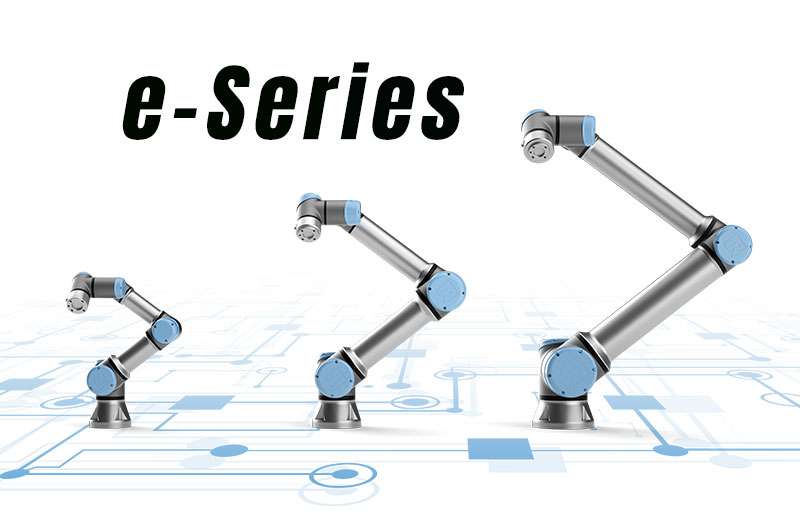
Compact, precise e-Series collaborative robots designed for picking, packaging, and flexible material handling.

e-Series: Compact and Precise Collaborative Robots

Introduced in 2018, the e-Series represents Universal Robots' established generation of collaborative robotic arms, designed for applications requiring compact dimensions, precision, and flexible deployment. The family includes models such as the UR3e, UR5e, UR10e, and UR16e, covering different payload capacities and working reaches.

The UR3e is designed for smaller workspaces and lightweight handling, while the UR5e and UR10e accommodate progressively larger products and operating areas. The UR16e provides a higher payload capacity for applications involving heavier tools, components, or packaged goods.

Precision, Tool Power, and End-Effector Integration

The e-Series incorporates integrated force and torque sensing, repeatable motion control, and the PolyScope programming environment for configuring automated operations. Depending on the model, repeatability reaches approximately ±0.03 to ±0.05 millimeters, supporting applications requiring consistent positioning and controlled product handling.

The tool flange provides selectable 12-volt or 24-volt power alongside digital inputs and outputs, analog inputs, and RS-485 serial communication. These connections allow the robot to operate compatible electric grippers, vacuum valves, and sensors, although Ethernet cameras mounted at the tool generally require separately routed data cables.

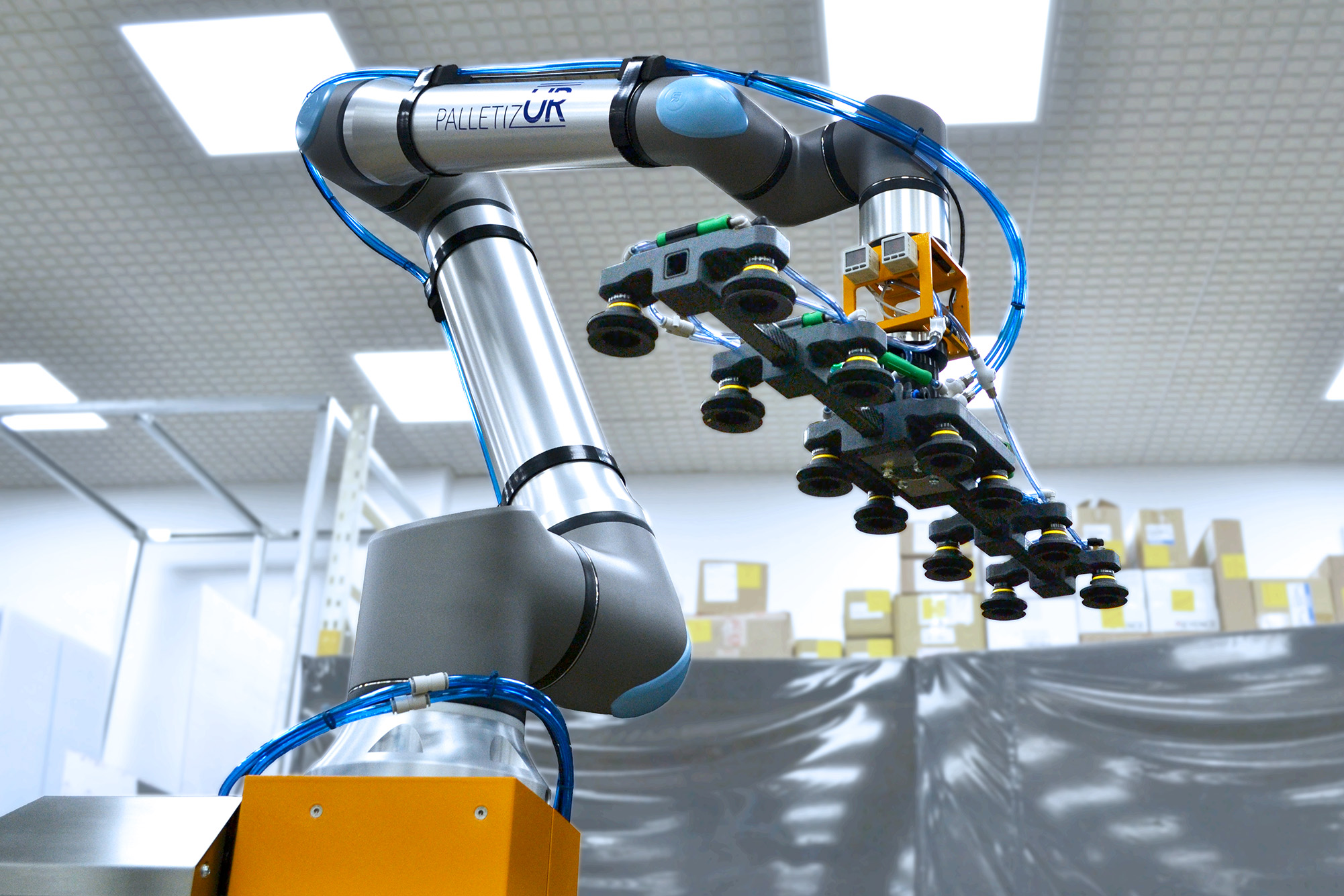
High-payload UR Series robotic arms equipped with palletizing end effectors for automated stacking and handling.

UR Series: Higher Payloads and Extended Reach

Introduced in 2022, the UR Series expanded Universal Robots' collaborative arm portfolio with redesigned mechanical systems capable of handling heavier payloads and larger working areas. The UR20 offers a standard payload capacity of 20 kilograms and a reach of 1,750 millimeters, while the UR30 provides a 30-kilogram standard payload and a reach of 1,300 millimeters.

These capabilities make the robots particularly suitable for handling larger cartons, transferring heavier components, and automating end-of-line palletizing operations. The longer reach of the UR20 can also help integrators access multiple work positions or larger pallet configurations from a single installation.

Motion Performance and Industrial Durability

The UR Series features redesigned joints, improved motion performance, and maximum tool-center-point speeds of up to 5 meters per second. Both the UR20 and UR30 provide repeatability specifications of approximately ±0.10 millimeters, prioritizing larger working envelopes and higher payload capacities over the tighter positioning tolerances available on certain smaller models.

An IP65-rated robotic arm provides increased protection against dust and water exposure compared with the IP54 rating of many e-Series models. These robots also retain integrated force and torque sensing, configurable safety functions, and tool-side electrical connections for compatible industrial grippers and sensors.

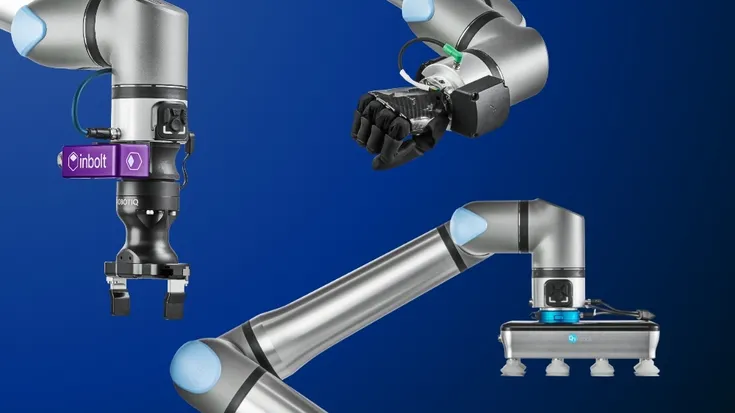
Next-generation g-Series collaborative robots with enhanced connectivity for smart grippers, cameras, and sensors.

g-Series: Seventh-Generation Robotic Arms

Introduced in 2026, the g-Series represents Universal Robots' seventh-generation collaborative robot platform, combining updated mechanical designs with expanded electrical and communication capabilities. The family includes models such as the UR18g-950, UR17g-1300, and UR10g-1750, with model designations indicating their approximate payload class and working reach.

These configurations allow integrators to select robotic arms for different combinations of product weight, operating distance, and installation requirements. Rather than simply increasing payload across every model, the new generation emphasizes a combination of mechanical performance, flexible deployment, and improved integration with modern automation equipment.

Advanced Tool Connectivity and Sensor Integration

One of the most significant upgrades is enhanced tool-flange connectivity, which supports selectable 24-volt and 48-volt power with up to 3 amperes of continuous current and 5 amperes of peak current. At 48 volts, this provides up to 144 watts of nominal continuous electrical power for compatible end effectors, substantially expanding the available power compared with earlier generations.

The robots also introduce integrated 1-gigabit Ethernet at the tool flange alongside M8 connections supporting digital I/O, analog inputs, and RS-485 communication. These interfaces simplify the installation of arm-mounted cameras, intelligent grippers, vacuum sensors, and other accessories by reducing the need for additional cables routed externally along the robot.

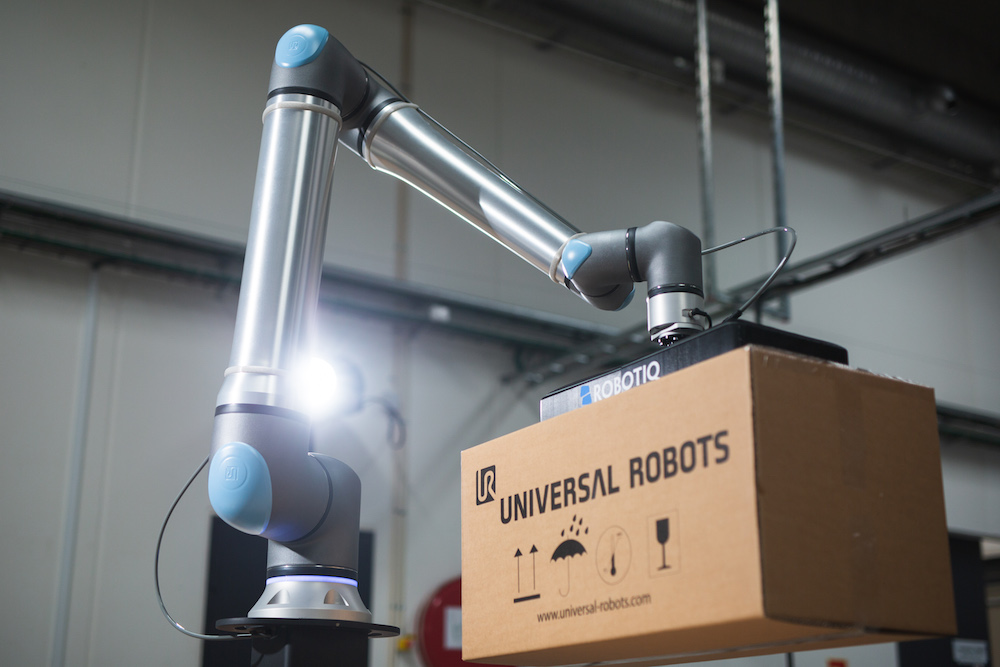
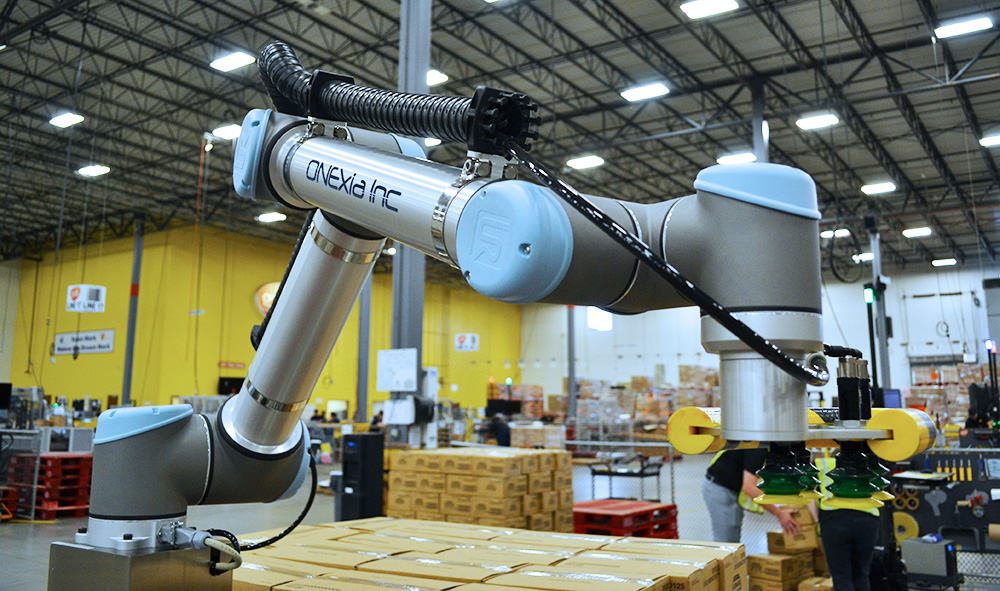
A Universal Robots arm uses a gripper to lift and transfer cardboard boxes in an automated workflow.

Grippers, Vacuum Systems, and AI Vision

Universal Robots arms can be equipped with interchangeable end effectors, including mechanical grippers, vacuum suction tools, and specialized handling devices selected for particular products. In warehouse automation, suction grippers are frequently used for cartons and packaged goods, with external vacuum generators supplying suction while electrical signals control valves and monitor gripping conditions.

Machine vision systems can identify products, estimate their positions, and calculate suitable gripping points before the robot executes a picking movement. These capabilities are typically provided through external cameras and specialized software, allowing integrators to combine Universal Robots hardware with AI-powered perception and planning technologies.

Programming, Integration, and Complete Picking Systems

Universal Robots provides the PolyScope programming environment and the UR+ ecosystem of compatible accessories, software, and integration technologies. The robots can also be incorporated into larger automation architectures that coordinate conveyors, inventory systems, vision processing, and robotic motion through external controllers and industrial communication interfaces.

For warehouse operators, selecting the appropriate arm involves evaluating payload, reach, cycle time, end-effector requirements, available connectivity, and the surrounding material handling infrastructure. Universal Robots' product families provide different combinations of these capabilities, giving automation integrators a flexible foundation for developing robotic picking, sorting, packaging, and palletizing solutions.

Comments

Log in to leave a comment
No comments yet. Be the first to comment!
Hello!