Dream Cloud
ProductRoboticsArms

Anyware Robotics Pixmo: Autonomous Truck Unloading, Palletizing, and Warehouse Transport

Explore how Anyware Robotics Pixmo combines AI-powered robotic handling, autonomous navigation, and palletizing capabilities to move goods from incoming trailers to warehouse storage areas.

 Anyware Robotics Pixmo: Autonomous Truck Unloading, Palletizing, and Warehouse Transport

Anyware Robotics Pixmo automates truck unloading and warehouse receiving operations.

DDream CloudOct 21, 2026United States, North America

Introducing Anyware Robotics Pixmo

Anyware Robotics is a robotics company based in Fremont, California, specializing in autonomous mobile manipulation systems for warehouse and industrial applications. Its flagship robotic platform, Pixmo, combines an autonomous mobile base, an industrial robotic arm, and AI-powered perception software to automate material handling operations. Unlike traditional warehouse robots designed for a single fixed task, Pixmo is developed as a flexible platform capable of performing multiple functions, including truck unloading, palletizing, depalletizing, and transporting goods between warehouse work areas.

Pixmo's design allows it to handle cartons throughout different stages of warehouse receiving and storage. The robot can retrieve boxes from floor-loaded shipping containers, transfer them onto conveyor systems, and perform palletizing operations at designated warehouse locations. Its mobile platform also enables autonomous navigation between workstations and pallet storage areas, allowing the same robotic system to support multiple material handling activities. By combining mobility with robotic manipulation, Anyware Robotics aims to reduce the need for separate automated systems dedicated exclusively to unloading, transportation, and pallet handling.

Connecting Receiving, Transport, and Storage

Traditional warehouse receiving operations often involve several separate processes. Workers unload incoming trailers, transfer cartons onto conveyors or pallets, move goods using forklifts or pallet jacks, and organize inventory in designated storage areas. Although individual stages can be automated, connecting them typically requires multiple specialized systems. Fixed robotic palletizers, autonomous mobile robots, and conveyor networks may each perform different functions, creating additional integration requirements and infrastructure costs.

Pixmo offers an alternative through a mobile robotic architecture that combines transportation and manipulation capabilities. After supporting unloading operations, the robot can navigate to another workstation and perform palletizing tasks, including placing cartons onto stationary pallets. This allows warehouse operators to use robotic automation across different stages of material handling rather than limiting the system to a single loading dock. The ability to reposition and perform different tasks also provides operational flexibility, particularly for facilities where receiving volumes and palletizing requirements change throughout the day.

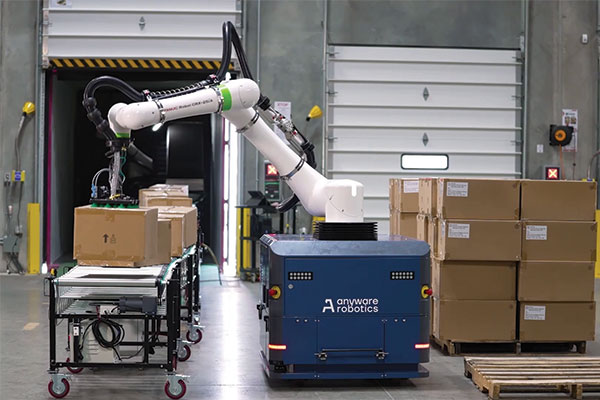
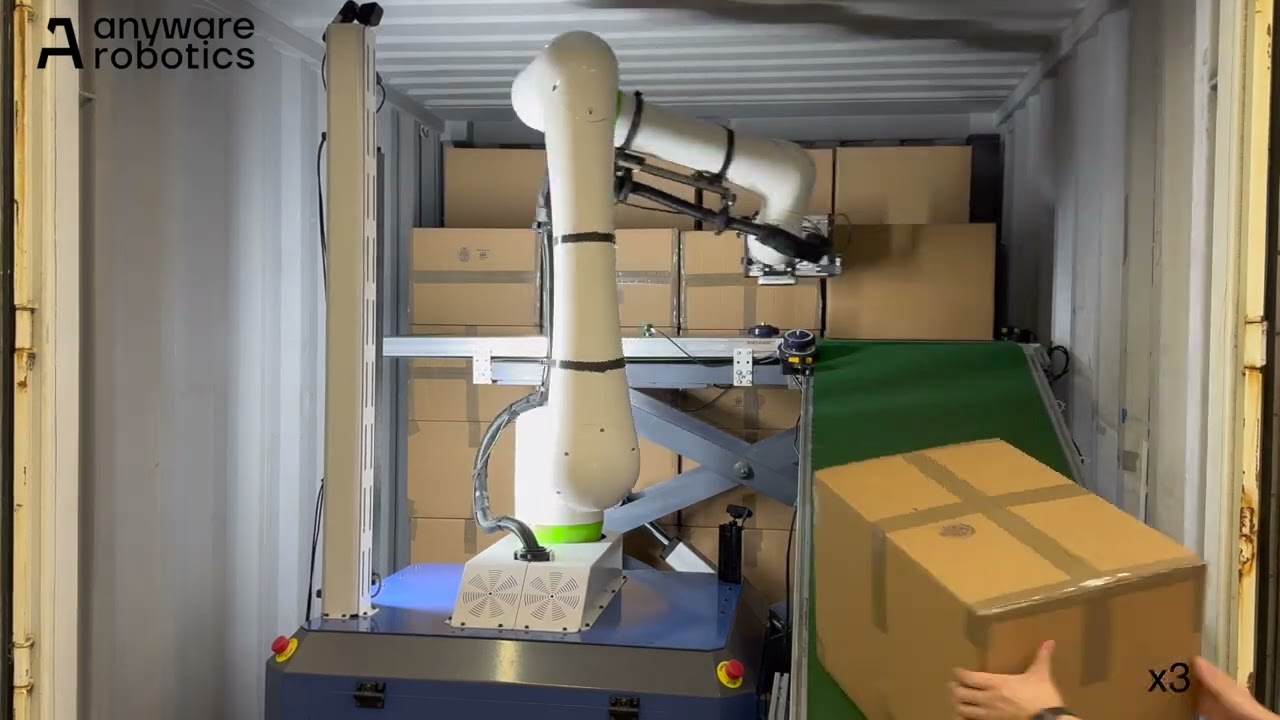
Anyware Robotics Pixmo unloading boxes inside a shipping trailer.

AI-Powered Robotic Unloading and Palletizing

Pixmo uses artificial intelligence, computer vision, and robotic motion planning to recognize cartons and determine how to handle them. Its perception system analyzes package dimensions, positions, and surrounding obstacles, allowing the robotic arm to retrieve cartons from irregular stacking arrangements inside trailers. A vacuum-based gripping mechanism secures packages during movement, while the control software coordinates picking trajectories and placement positions. This enables the robot to process floor-loaded freight without requiring every carton to arrive in a predetermined orientation.

The same robotic manipulation technology supports palletizing and depalletizing operations. Pixmo can identify cartons, lift them using its robotic arm, and position them onto stationary pallets according to the requirements of the handling task. Its mobile design allows the robot to approach pallet locations from different positions, providing flexibility compared with fixed palletizing equipment. For warehouse operators, combining unloading and pallet handling capabilities creates opportunities to automate multiple repetitive processes using a common robotic platform, although individual workflows still require appropriate configuration and integration.

Autonomous Navigation Between Warehouse Work Areas

Pixmo operates on a mobile base designed to navigate warehouse environments and reposition itself between material handling locations. Its navigation technology uses sensors and autonomous control software to move through designated operating areas while detecting surrounding obstacles. Unlike stationary robotic arms that remain permanently installed at a single workstation, Pixmo can travel between loading docks, palletizing stations, and storage areas. This mobility enables the robot to support different warehouse operations without requiring employees to manually transport the robotic system between every task.

In a receiving-to-storage workflow, Pixmo can operate at an unloading location before traveling to a designated pallet handling area. At the destination, its robotic arm can transfer cartons onto stationary pallets, allowing inventory to be organized for subsequent storage or distribution. The system's ability to combine navigation and manipulation is particularly useful in warehouses where goods must move between multiple workstations. Rather than relying exclusively on fixed conveyors or separate robotic transport systems, facilities can use mobile manipulation to connect handling tasks across different operational areas.

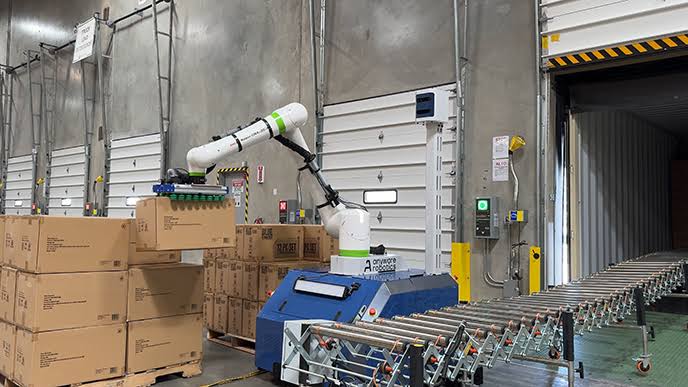
Pixmo uses robotic manipulation to stack and organize boxes onto pallets.

Integrated Warehouse Receiving and Pallet Storage

Pixmo is designed for distribution centers, third-party logistics providers, retail warehouses, and fulfillment facilities that handle large volumes of incoming cartons. These operations frequently involve unloading containers, transporting merchandise, building pallets, and organizing goods for storage or outbound distribution. The robot's combination of unloading and palletizing capabilities allows it to address several of these activities. Its mobility also makes it suitable for facilities where pallet locations and handling requirements vary across different warehouse zones.

One potential application is a coordinated receiving workflow in which Pixmo unloads cartons from an incoming trailer, supports their transfer into the facility, and subsequently navigates to a pallet storage area to perform palletizing operations. At these locations, the robot can place cartons onto stationary pallets, preparing inventory for forklift handling, storage, or additional processing. Such workflows demonstrate the potential of mobile manipulation systems to connect receiving and storage activities. The precise level of end-to-end automation depends on the facility layout, available equipment, and software integration.

Operational Efficiency and Flexible Automation

Pixmo's primary operational advantage is its ability to support multiple warehouse functions using a mobile robotic platform. Traditional automation projects often require separate investments in unloading equipment, palletizing robots, and material transport systems. By combining robotic manipulation with autonomous mobility, Pixmo offers an approach that may reduce equipment duplication and allow automation resources to be reassigned as operational needs change. Warehouse operators can potentially use the robot for unloading during busy receiving periods and palletizing or other material handling tasks when inbound volumes are lower.

The platform also offers opportunities to reduce repetitive manual lifting and improve the consistency of warehouse material handling. Automating carton retrieval, pallet placement, and movement between work areas can allow employees to focus on supervision, inventory management, and exception handling. Its flexible architecture is particularly relevant to existing warehouses that want to introduce automation without committing to extensive fixed infrastructure. As mobile manipulation technology continues to develop, Pixmo illustrates how robotic systems can evolve from specialized equipment into versatile warehouse automation platforms capable of supporting several connected operations.

Comments

Log in to leave a comment
No comments yet. Be the first to comment!
Hello!